
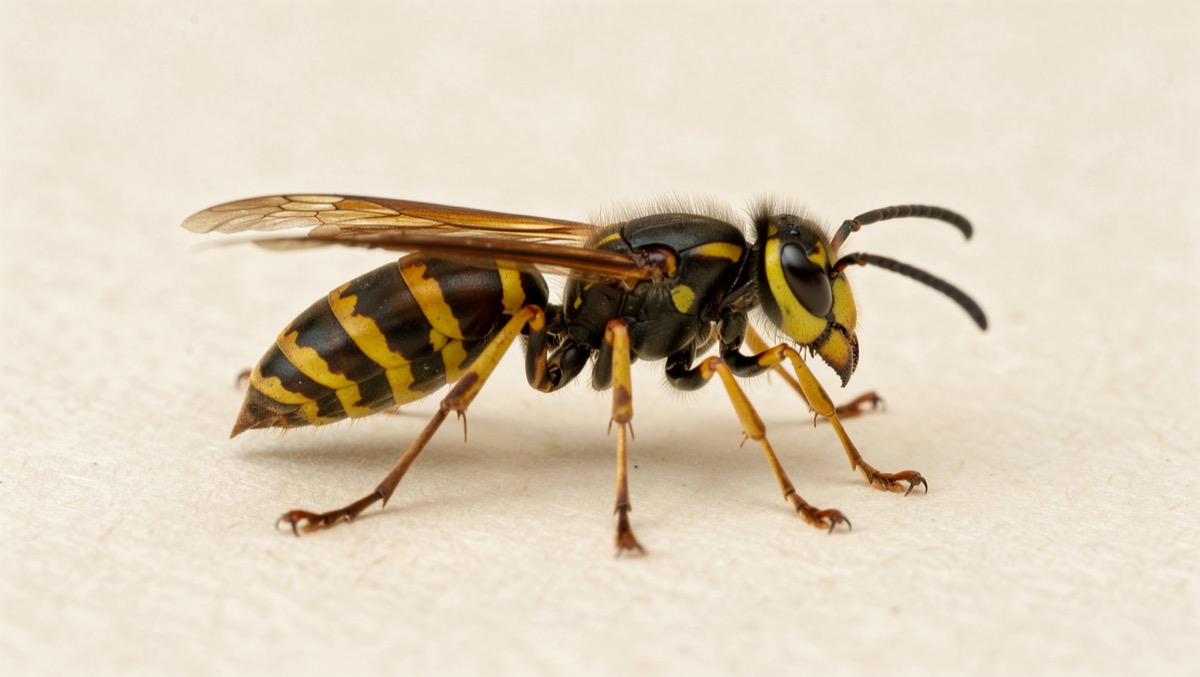
The situation
Owner called in early June after two prior summers of customer yellowjacket complaints and one anaphylaxis incident that required paramedic response. Liability premium was about to increase if another incident happened. The restaurant could not close patio service during peak July–September tourism — patio revenue represented roughly 60% of summer earnings. Previous provider had been doing one-off nest removals when reported, which meant stings were already happening before treatment.
The assessment
Full exterior survey identified six likely yellowjacket nest establishment zones on the restaurant property: two soffit voids at the back kitchen elevation, a raised-bed planter wall at the patio edge, a dumpster corral with ground-nest history, a decorative cedar arbour, and an adjacent public walkway with historical ground nests. Nearby beachfront parks were also identified as regional queen population sources. Baseline assessment completed by early June — before the first workers fledged locally.
The intervention
12-week structured monitoring program spanning June 15 through September 15. Weekly site visits inspecting all six identified zones for early-nest activity. Bait-trap network along property perimeter to reduce regional forager activity. Twofold response protocol: (1) any active nest identified during weekly inspection was treated same-visit before worker count exceeded 100; (2) any customer sighting during service hours triggered a 90-minute response promise, with rapid-response treatment completed after final seating. Staff training session in week one on safe yellowjacket awareness and incident reporting. All customer-reportable food-waste zones (organics bins, patio trash) fitted with vespid-excluding lids.
The outcome
Zero customer stings during the 12-week peak. Four live nests treated (two in early stages, two mid-stage — none ever reached mature size). Response time to staff-reported sightings averaged 42 minutes. Owner reported zero customer complaints related to wasps, compared with approximately 8–12 per season in each of the preceding two years. Liability premium held flat at renewal. Patio revenue grew year-over-year.
Why reactive nest removal wasn't working
Waiting for a customer sighting or a reported sting means the nest is already established and the worker population is already in daylight foraging pattern. By the time treatment happens, incidents have already occurred. Structured weekly monitoring catches nests at the 20–30 worker stage — before detection by customers — and the combined perimeter bait-trap network pulls regional foraging activity away from the patio seating. For public-facing hospitality with liability exposure, this preventive protocol is the only reliable approach.
Customer outcome“We'd been reactive for years and it wasn't working. The Wild Pest ran a full weekly program from June through September — we never had a customer sting complaint, our insurance stayed flat, and our patio revenue was up 14 percent year over year. Money well spent.”
Book your own assessment
Every job gets the same documentation standard — photos, findings, protocol, outcomes. 60-day pest guarantee plus 3-year exclusion warranty on every treatment.